Best Hydroponic Systems for Small Flats and Apartments UK: Space-Saving Indoor Growing
Growing food in a flat used to mean window herbs and not much else. Hydroponics changes that entirely. By growing plants in nutrient-rich water instead of soil, you can produce salad leaves, herbs, and even dwarf tomatoes in a space the size of a bookshelf. The catch isn't the technology—it's choosing a system that actually fits your flat without dominating your living room.
Why Hydroponics Suits Small Spaces
Traditional growing demands depth: soil, space to let roots spread, room for height. Hydroponics flips this. Plants grow closer together because nutrients arrive directly at the roots rather than searching through soil. You don't need a south-facing window; a decent grow light does the work. And crucially, you're looking at weeks to harvest, not months. Lettuce ready in 30 days, not 60.
For renters, there's a further advantage: hydroponics is reversible. No permanently altered walls, no soil stains that guarantee a deposit hit. Everything sits on a shelf or table.
The trade-off is upfront cost and electricity use. A basic system costs £80–200. Running a grow light uses perhaps 30–50W continuously, depending on the light and how many hours daily. That's roughly 50p per month extra on your bill for a standard LED array, though more powerful setups cost more.
Room-by-Room System Planning
Before buying anything, measure. Hydroponics systems come in surprising sizes once the grow light mount is added. A countertop lettuce garden might be 60cm wide and need another 40cm clearance above for the light bracket.
Kitchen shelving works well if you've got a sturdy shelf with electrical access nearby. Most flat kitchens have worktops with plug sockets within a metre or two. A narrow vertical system (sometimes called a tower garden) uses maybe 30cm of floor space but needs 1.5 metres of height. Check your ceiling first.
Dedicated corner is ideal if you have one. Even a 1m × 1m corner can hold a countertop system plus grow light, leaving room to walk past. Ensure airflow isn't blocked—stagnant air invites powdery mildew indoors, which spreads fast in closed flats.
Window ledges can work if you don't mind the aesthetic of a grow light indoors (they're usually white or black and about the size of a desk lamp) and you're not bothered by the heat from the bulb slightly fogging condensation.
Avoid putting systems next to radiators or heat sources; temperature fluctuations stress plants. Also avoid direct sunlight if using LEDs—dual light sources confuse plants and waste electricity.
System Types for Flats
Deep Water Culture (DWC) is the simplest and cheapest. A bucket with an air pump, net pot, and air stone. You suspend plants above the water in a foam insert and the air pump keeps roots oxygenated. Costs £40–80 for a basic setup. Downsides: you need to change the water every few weeks (a chore with a full bucket), and temperature matters—cold flats can slow growth. Best for: beginners on a tight budget.
Nutrient Film Technique (NFT) runs a thin film of nutrients down a sloped channel where roots sit. More elegant and uses less water, but if the pump fails, plants dry out fast. Often integrated into compact shelving units. Costs £100–180. Suits leafy greens but struggles with heavier fruiting plants. Best for: lettuce, spinach, basil, microgreens.
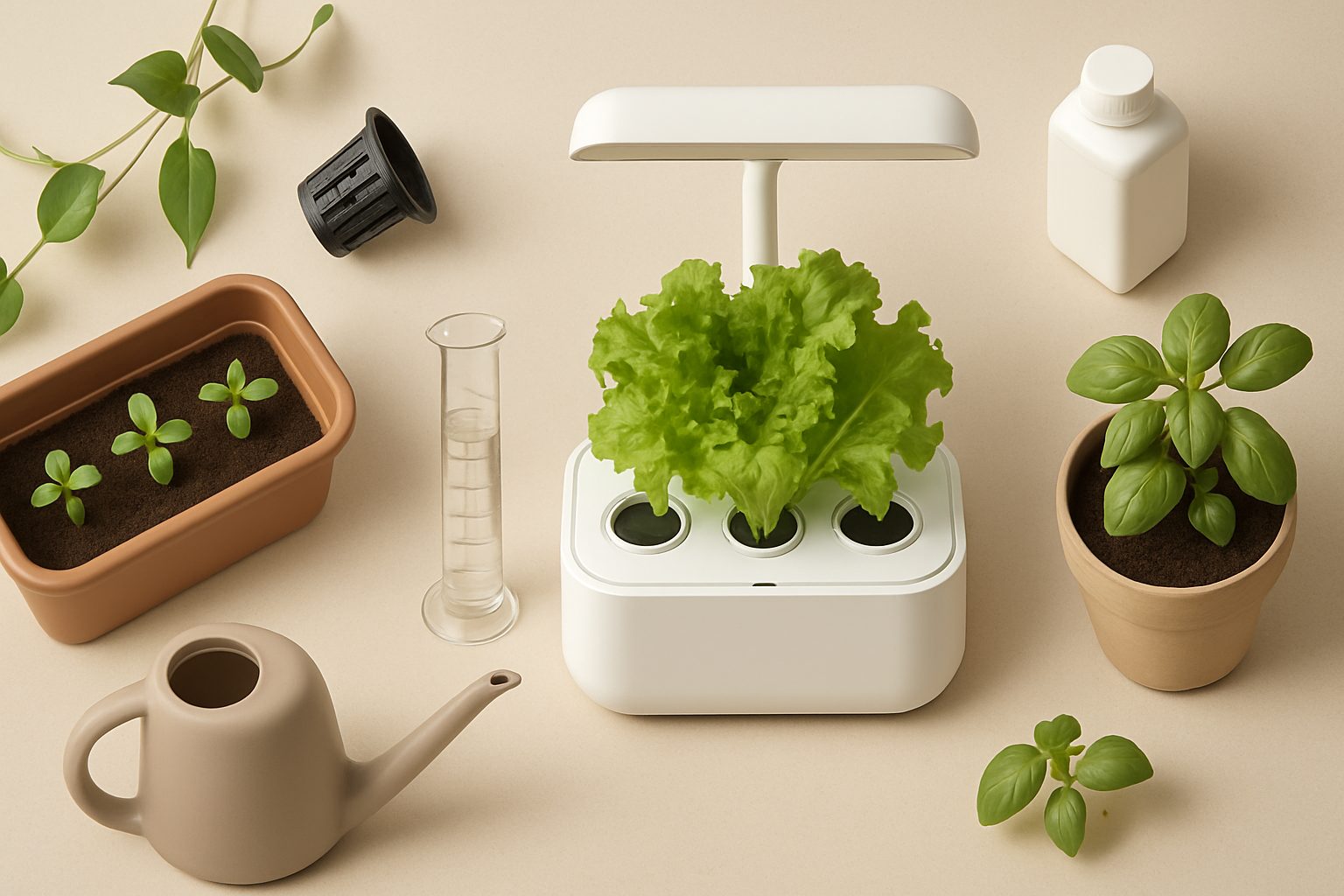
Countertop Hydroponic Gardens (the all-in-one kind) are designed exactly for flats. A water reservoir sits beneath a growing tray, with an integrated grow light that clicks on above. Most hold 6–12 plants. Costs £120–250. Electricity is already accounted for—usually 20–30W. The advantage is simplicity: add water, add nutrients, hit the timer. The downside is limited flexibility once you outgrow them; you can't easily add more plants or swap systems. Best for: someone trying hydroponics for the first time.
Vertical or Tower Systems stack plants in a spiral or column, using minimal floor space. A single tower might hold 30 lettuce plants in 30cm diameter. Costs £150–300. The learning curve is steeper—water distribution has to be perfectly balanced, or lower plants don't get nutrients. Best for: once you've mastered basics.
Practical Essentials You'll Need
Beyond the system itself, budget for:
- A grow light if the system doesn't include one: £30–80 for a basic LED. Don't buy cheap incandescent grow lights; they generate too much heat in a flat.
- Hydroponic nutrients: £8–15 per bottle, lasts months. Brands differ (Canna, Vitalink, Masterblend), but UK-specific options are fine and cheaper than imports.
- pH test kit: £12–20. Essential. UK tap water is often alkaline, and your nutrient solution needs to be 5.5–6.5 pH for uptake. Without testing, plants suffer mysteriously.
- Replacement air filters and stones if you choose DWC or NFT: £5–15, lasts months.
Don't start with every gadget. A system, nutrients, and a pH kit are enough. You'll learn what else you actually need.
Water and Electricity Realities
Most UK flats have decent water quality. Tap water works, though many growers let it sit overnight to let chlorine evaporate. If your local water is very hard (south-east England) or very soft (Scotland), adjusting nutrients is straightforward once you know your water profile—a single £20 water test gives you this.
Electricity cost is honest: a 40W grow light running 16 hours daily uses 0.19 kWh per day. At typical rates, that's £20–25 per year, less than a coffee habit.
Honest Drawbacks
Hydroponics in a flat means managing humidity. A growing system evaporates water constantly. On a shelf in a living room, this can feel like you're humidifying the space. You're not—hydroponics uses less water than soil—but perception differs. Opening a window occasionally solves it.
Pests are rare indoors, which is brilliant. Nutrient imbalance is not rare, especially when you start. Yellowing leaves usually mean nitrogen deficiency or pH drift, both fixable but requiring troubleshooting.
And there's the noise factor. Air pumps are quiet, but some growers find them intrusive at night. Most pump systems sold for UK flats are silent or nearly so.
Starting Small Makes Sense
Your first system doesn't need to be fancy. A £100 countertop garden with lettuce or herb seedlings will teach you more in two months than reading about hydroponics ever will. Once you've seen a full crop through, you'll know whether scaling up to a tower system or moving to a dedicated corner is worth it for your flat and your time.
The best system is one you'll actually maintain.
More options
- Home Hydroponic Systems (Amazon UK) (Amazon UK)
- Full-Spectrum LED Grow Lights (Amazon UK) (Amazon UK)
- Hydroponic Nutrients & Fertilisers (Amazon UK) (Amazon UK)
- Complete Grow Tent Kits (Amazon UK) (Amazon UK)
- Hydroponic Air Pumps & Air Stones (Amazon UK) (Amazon UK)